
Teaching. Excellence.
Capturing (and celebrating) a personal "mountain-top experience."

I fancy myself a rather humble guy (…he typed with confidence into a newsletter he was about to send to 500 friends, acquaintances, and strangers). I know I’m not the humblest (if I were, it wouldn’t be something I’m bragging about), but — scale of 1 to 10 — I’d say I’m at least 6+ in the Humility Department. (🤦)
In any case, I want to completely set aside any pretense of humility for the next ten minutes of your time so I can share, honestly, the pride in accomplishment that I feel on this, the absolute last day of this episode in my teaching career. I want to — as my friends in Minnesota might have put it, though without the embarrassment or passive aggression — “Toot my own horn.”
Let me start by acknowledging, even apart from the performative humility above, that there’s a certain paradox for me in taking pride in metrics. I teach my students, constantly, to beware of the status anxiety, value capture, and achievementism that comes from equating excellence with any quantifiable measure of performance. I also write about it here. And I take a certain pride, to be honest, when the value of my effort is less than fully visible in terms of the incentive structures and games within which I operate. To quote the founder of one of the great philosophical schools of our time, “Man, this ain’t my dad, this is a cell phone…I’m not a part of your system.”

Now, let me set that all aside for just a moment.
This semester — all semester — has been a bit of a “mountain top experience” for me. I learned that term on retreat when I was younger, as a reminder not to expect the “honeymoon phase” to last forever, and I try to keep it in mind every time I feel like things couldn’t possibly be going better. In the past, I’d get attached to that feeling and start panicking when it would go away. I’d feel the withdrawals of my success between projects or in their growing period, and I’d look to fill it with all manner of ego-expanding plays for attention, like Facebook histrionics and humblebrags, or brashly sh*t talking over drinks or in a group chat. I would be “Thrilled to announce” anything that smelt of prestige or honor. I even spent almost a whole year producing viral TikToks…(remember that “era,” me?)
So this past semester, I was, for the first time in a long time (possibly ever), able to simply “enjoy the ride.” I didn’t know why so many projects were coming to fruition at the same time, or why opportunities kept falling into my lap. I kept feeling like a sense of greater connection in the classroom and beyond it; I felt genuinely excited at my colleagues’ achievements and was able to rest easy in my own. Most importantly, I felt pure joy when I saw my students succeeding, and — while I hope I had something to do with any of that success — I felt secure enough to simply marvel and celebrate, a feeling I’ve gotten more and more used to as a father of beautiful, intelligent, and charismatic children.
In retrospect, “connecting the dots,” I recognize something providential in this episode; something grace-filled; something operating far beyond my capacity or pay grade. Like a child at his father’s bent knee, hammering the final wall of a small birdhouse, I felt pride in my agency without any illusion that the new home was a pure expression of my work and mine alone.
Further, I started sharing these moments with friends and colleagues, many of whom collectively create the conditions for any of the success that I experience. And, most importantly, I started sharing them with Shayla, who creates the foundation and supports the ceiling for all our shared endeavors.
About a week ago, after I decided to step away from Notre Dame and take on a project bigger and more ambitious than I’d ever dreamed possible, my students sent me a sixteen-minute video filled with gratitude and encouragement. It meant as much to me, professionally and personally, as any honor I’ve ever received. And Shayla and I watched it through twice, tears streaming down our faces, gleaming visibly by the soft glow of my iPhone’s screen as they fell silently into the soft darkness of our pillows.
I’ve told my students a thousand times that learning isn’t about the final grade. Nor is teaching about the relative and subjective quality captured by things like student evaluations. Still, grades can mean something — they can capture something — and it’s not always a mistake to see in them a reason for pride and celebration of a job well done.
Risking any credibility I’ve ever gained in incorporating humility into my public or teaching personas, then…“I’m thrilled to announce” the results of this, my final semester teaching at Notre Dame. With gratitude to Shayla, my family and friends, and every single student whose hard work and character these numbers and comments reflect and represent. (And, of course, Claude.ai, whose design skills rival those of the most talented freshman design major I’ve ever encountered; where would we be without you, Claude.ai?)
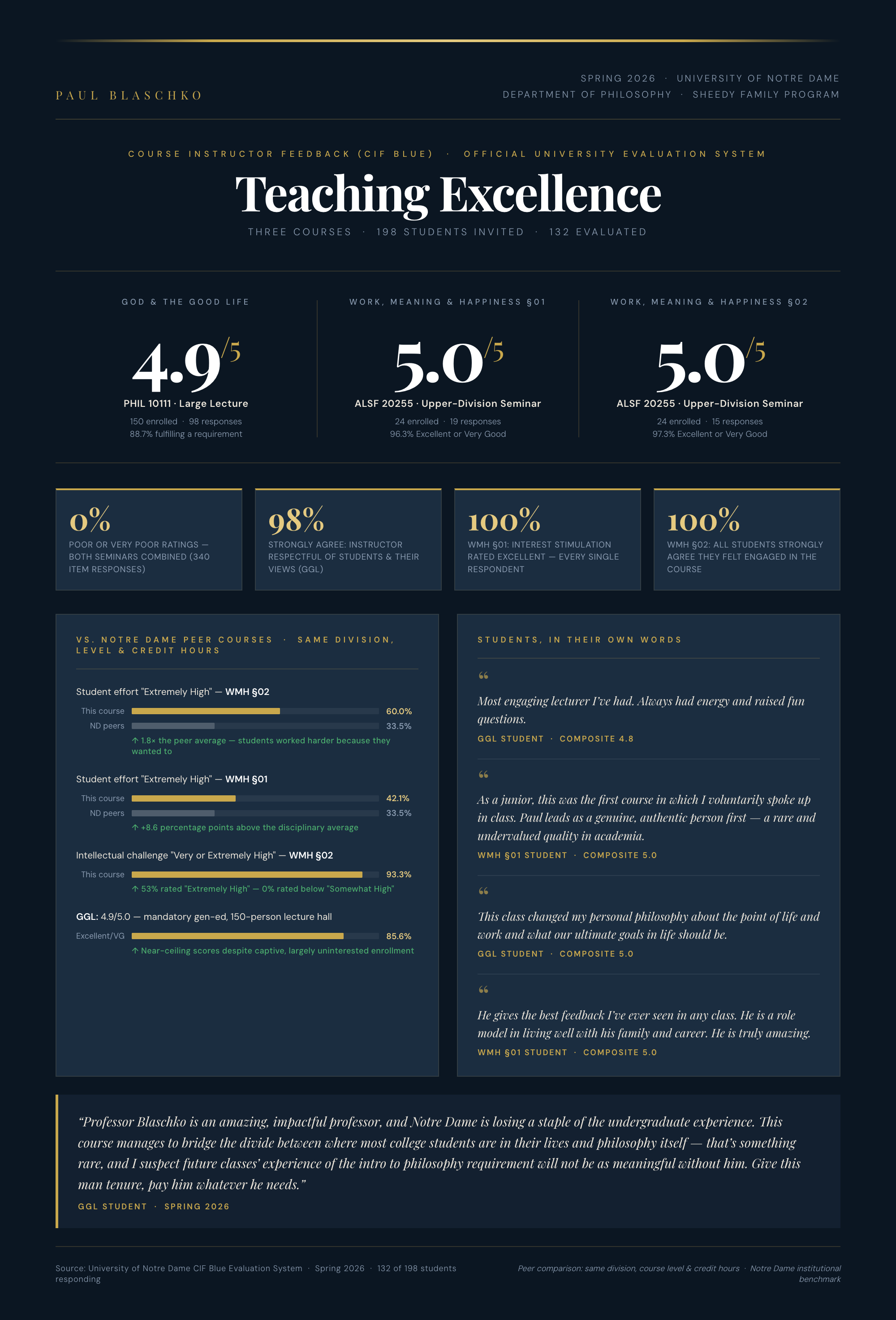
1. “Paul’s honesty and willingness to engage with difficult, pressing questions are among his greatest strengths as an instructor — particularly in a philosophy course, where that kind of openness is essential. His ability to address profound topics in a casual, approachable way made me feel more supported and willing to participate than I ever have in a classroom setting. As a junior, this was the first course in which I voluntarily spoke up in class. Most of all, I found Paul to be an exceptional professor because he leads as a genuine, authentic person first. This is a rare and undervalued quality in academia, and one I haven’t observed many other professors intentionally cultivate. It created an environment where students felt safe to think out loud, take intellectual risks, and truly engage with the material.” — Work, Meaning & Happiness §01 student, Composite 5.0
2. “Professor Blaschko is an amazing, impactful professor, and Notre Dame is losing a staple of the undergraduate experience. This course of his is a real gem and manages to bridge the divide between where most college students are in their lives and philosophy itself. That’s something rare, and I suspect future classes’ experience of the intro to philosophy requirement will not be as meaningful without him. Give this man tenure, pay him whatever he needs.” — God & the Good Life student, Composite 5.0
3. “Professor Blaschko has a unique gift of relating difficult concepts and ideas to students in a language that’s easy to understand. His humor mixed with passion and deep knowledge of philosophy has made someone like me — who previously had no interest in it — read about philosophy in her free time. This class has had an incredible impact on my life, and I believe it’s caused me to re-evaluate my routine, values, and career aspirations so that heaven, not work, is my ultimate goal. The discussions of this class is what I hope comes to mind when I think of my Notre Dame education.” — Work, Meaning & Happiness §01 student, Composite 5.0
4. “Paul did an amazing job at personally connecting to a lecture hall of hundreds of students. I felt he personally engaged very well and simultaneously pushed us to think more deeply on the given content while also developing our unique stances. His lighthearted demeanor made me feel very comfortable in the class. For me GGL embodied what learning should truly be — a place where you can engage with peers and faculty without necessarily worrying about the grade. Paul’s primary focus was our well-being and philosophy, not some stupid letter grade.” — God & the Good Life student, Composite 5.0
5. “Everything. Paul takes so much time to meet with us, is constantly available for coffee, asks insightful questions, gives the best feedback I’ve ever seen in any class, and genuinely cares about his students. I believe he is doing the real work, the real research, into how to meaningfully direct all of our lives. Paul is one of the best professors I’ve ever had and I’m so grateful to be in his class. He is a role model in living well with his family and career. His network is exceptional but he doesn’t sacrifice any deep thinking. He is truly amazing.” — Work, Meaning & Happiness §01 student, Composite 5.0
6. “Professor Blaschko is a truly excellent instructor. I had heard as much and trusted him with my Monday morning time slot — the wisest registration choice I have made yet. He helped me start off every week in a positive, contemplative frame of mind. His lectures are incredibly engaging, and he shows a passion for philosophy that is infectious. Good luck enticing future students into philosophy majors and minors without him. Professor Blaschko, if you are reading this, thank you for everything.” — God & the Good Life student, Composite 5.0
7. “Paul, I think you might be the only professor at ND who actually reads all of these, so I want to respect your time. The course was excellent. Each reading perfectly expanded upon the next and the argumentative essays and application reports made me better at disassembling arguments and helped me discover new philosophies and viewpoints. All of these were incredibly applicable to my working life, as I constructed a notion of each job’s virtues and vices that I can augment with experience in these fields. Everyone in the class was brilliant and you brought them together wonderfully in discussion. Thank you.” — Work, Meaning & Happiness §01 student, Composite 5.0
8. “The assignments were incredibly engaging, particularly the philosophical application reports, which challenged us to experiment with meaningful changes in our lives related to course content and reflect on those experiences. This kind of active, personal engagement with the material is rare and difficult to fully articulate. The level of meaningful learning I experienced in this course is difficult to describe. I genuinely believe every Notre Dame student should have exposure to this type of course — it addresses something our community is missing and has the potential to fill that gap in a profound way.” — Work, Meaning & Happiness §01 student, Composite 5.0
9. “Professor Blaschko is my favorite professor I have had at Notre Dame. His passion and drive to connect with his students, unpack the mysteries behind hierarchy, work, and power, and uphold Sheedy’s mission in everything he does is incredible to witness. Most philosophy professors have you read and analyze literature from a thousand years ago and understand why it was important at the time. Professor Blaschko has taught me how the meaning of work has shifted over time, why dated perspectives on work are important now, and why it is important to understand differing perspectives on what ‘good work’ is before entering the workforce ourselves. Particularly at a university that prides itself on business students ‘growing the good,’ I feel his role was monumental in establishing what ‘good’ even means. Aimless work is unproductive work. Why have the vague goal without defining its components?” — Work, Meaning & Happiness §02 student, Composite 5.0
10. “Professor Blaschko is such an amazing professor, leader, and mentor that I am not sure I can express it in this statement. I have learned so much in this course through every lecture, assignment, and discussion. Professor Blaschko takes the time to clearly understand every student and to provide extremely valuable feedback that has helped me to rethink my entire career and meaning of work in my life. Professor Blaschko is the type of professor that makes Notre Dame what it is — and this university, the philosophy department, and the Sheedy Family Program will not be the same without him.” — Work, Meaning & Happiness §02 student, Composite 5.0
Thank you.