Finding Purpose in Work
A Syllabus for Curious Achievers

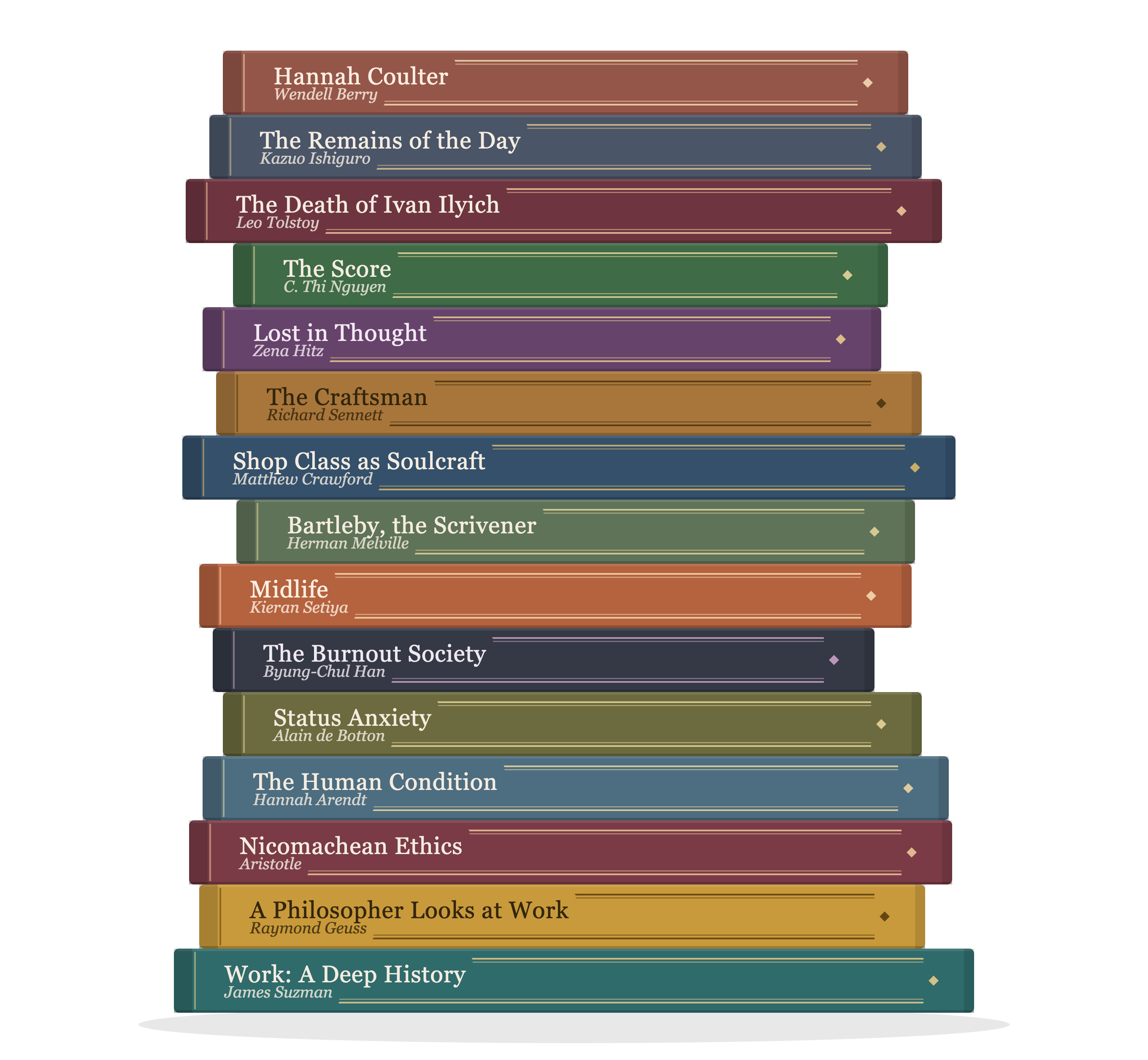
I’m often asked for recommendations of books on the philosophy of work, so I decided to put together a miniature version of the syllabus for my class aimed at someone looking for a self-paced introduction to the subject. (If you just want a straightforward list without the context, you can find that by scrolling down to the illustration at the very bottom.) These aren’t all the most foundational texts on the subject, nor are they the most important for someone looking for a comprehensive scholarly overview. Rather, they are the texts I’d recommend someone read if they wanted to answer these key questions:
What is our contemporary culture’s relationship to work?
How does our understanding build on — or depart from — important historical conceptions that held sway until quite recently?
What do I want my relationship to work to look like?
What are the philosophical ideas I’d need to start the process of (re)integrating work into my vision of a life well-lived?
So, indulge me, if you will, in this exercise.
Welcome to Philosophy 201.
PHIL 201: Work, Meaning, and Happiness
Unit 1 - Work: What is it, and what’s it for?
Lecture 1:
Here are your readings:
Raymond Geuss, A Philosopher Looks at Work (Chapter 1)
James Suzman, Work: A Deep History, from the Stone Age to the Age of Robots (Whole book)
Gary Gutting, What work is really for (New York Times Op-ed)
There are many places to start in defining “work.” Raymond Geuss’s treatment may be the most natural place to start for the philosopher, but it’s dense and highly theoretical. In class, I started with the first chapter, contextualized Guess’s definition in class (and complicated it). So after that chapter, I’d recommend reading through Suzman’s illuminating historical survey of the subject. As with any “deep history,” I approached the book skeptical of its ability to make good on the promise to give a complete picture of such a vast subject in a single volume, and my skepticism grew when I realized the entire first half was devoted to a study of the pre-history of work (Suzman, an anthropologist, is clearly most confident in this topic as his own area of expertise). But my understanding of work in later historical epochs compounded based on this foundation, and I’ve found myself returning to this book time and again to situation my understanding of contemporary work in a richly detailed history. In my view, there’s no better place to begin.
Assignment: After reading Gutting’s op-ed, try to outline his central claims. What is his view about the relationship between work and leisure and other intrinsic goods? Why does he think liberal education is essential in a capitalist society that wants to “get work right?”
Extra credit: Read my paper, written with Claire Murphy, on how we should think about defining work in relation to human flourishing.
Unit 2 - Philosophies of Work
Lecture 2:
Readings:
Aristotle, Nicomachean Ethics (Excerpts)
Hannah Arendt, The Human Condition (Sections I. - IV.)
Firmin DeBrabander, Should Work be a Passion, or Duty? (New York Times Op-ed)
Of the major philosophies of enduring influence, I think virtue ethics (including stoicism) dominates in its value for thinking about work. There are many directions one could go, of course, and here the most obvious absence is the many contributions from utilitarianism (so consider that a side quest if you’d like to explore more).
Of these readings, I think Arendt needs the most context. She is the most interesting thinker to come out of mid-century existentialist thought. Far more readable than Heidegger, and more insightful than Sartre or even de Beauvoir, Arendt considers work and labor from a critical and historically-informed philosophical point of view. I was surprised to see Augustine and Aristotle among the most cited figures in early footnotes, but even more surprised by how seamlessly her treatment of their ideas illuminated the contemporary “human conditions” of labor, work, and action. (For a compelling introduction to her historical context and some important contemporaries, I’d also recommend The Visionaries.)
Assignment: We ask much of our work in the contemporary world. We want jobs that are not just dignified, but interesting, meaningful, and a source of personal growth. As Studs Terkel put it, “Work is about a search for daily meaning as well as daily bread, for recognition as well as cash, for astonishment rather than torpor; in short, for a sort of life rather than a Monday through Friday sort of dying.” Write 400-500 words answering the question: What are you looking for in your work? And when have you come closest to finding it? Is there anything in the philosophy of Aristotle or Arendt that leads to to reconsider the role work currently plays in your life?
Unit 3 - How we suffer
Lecture 3:
Pick a Path
Status Anxiety
Alain de Botton, Status Anxiety)
Arthur Brooks, Success Addicts (Article from The Atlantic)
George Saunders, The Semplica Girl Diaries (Short story originally published in The New Yorker)
Burnout
Byung Chul Han, The Burnout Society
Kieran Setiya, Midlife: A Philosophical Guide
Derek Thompson, Workism is Making Americans Miserable
Herman Melville, Bartleby the Scrivener (Uncanny. Absurd. Hilarious. Puzzling. This short story is a profound reflection on the American work ethic and its limits. If nothing else, read it so you can use the Bartleby’s catchphrase when you “can’t even” anymore: “I would prefer not to.”)
Unit 4 - Revaluing the work of our hands
For this unit, pick one of the following two books to read and reflect on:
(1) Matthew Crawford, Shop Class as Soulcraft: An Inquiry into the Value of Work
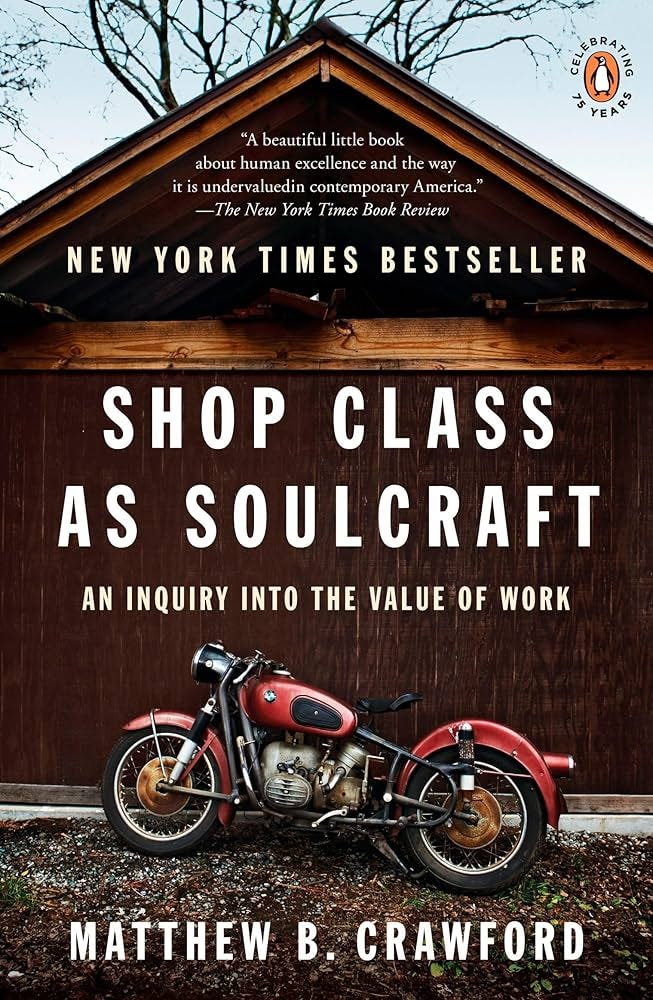
This book is a classic of the genre, and for good reason. Though you could simply read the article its based on if you’re pressed for time, it’s one of the rare book-length expansions that I think is well worth the effort. Crawford is a keen observer of his own varied experience with work, which ranges from blue-collar work as an electrician to so-called knowledge-work, veering into intellectual work in academia and then thought-leadership before circling back to the satisfaction of mechanical work with his decision to open his own motorcycle shop. The book also does triple duty: In addition to an essayistic introduction to various forms of contemporary labor, Crawford provides a critique of contemporary work that illuminates the ethic behind contemporary corporate life. He also draws on just enough classical sources to model how a conception of good work might be tied back to historically important ideas that go all the way back to ancient Greek philosophy. It’s a short and compelling read, light enough to take along to the beach but intellectually substantial enough to merit careful highlighting and marginalia.
(2) Richard Sennett, The Craftsman
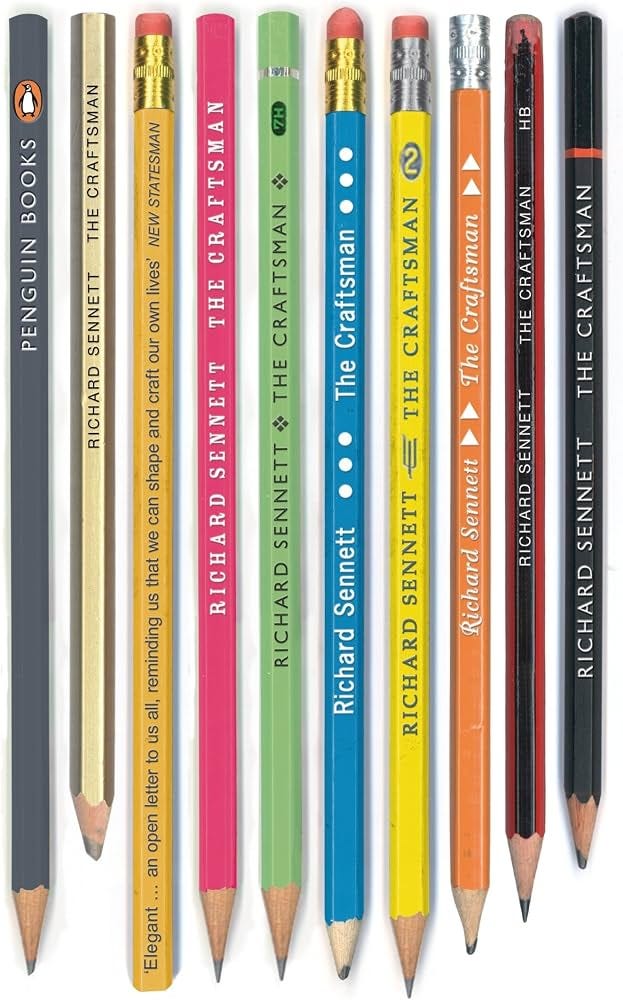
Richard Sennett was Hannah Arendt’s student, and his writing is even more accessible without losing historical or philosophical depth. In “The Craftsman,” Sennett examines the history of craftsmanship and defends this form of work against the two thousands year old philosophical bias toward intellectual and contemplative work. I couldn’t put it down, and I haven’t read a more enlightening perspective on the relationship between humans and machines (robots and replicants), despite the fact that Sennett was writing more than a decade before LLMs were even on the horizon.
Unit 5 - The end of work (revisited)
Lecture:
Readings:
Zena Hitz, Lost in Thought: The Hidden Pleasures of an Intellectual Life
Thi Nguyen, The Score: How to Stop Playing Somebody Else’s Game
Both of these books ask readers to consider the sources of ultimate value in life, and both do so, in part, by considering evolutions in the authors’ relationship to their own work.
And pick one of these novels:
Leo Tolstoy, The Death of Ivan Ilyich
Kazuo Ishiguro, The Remains of the Day
Wendell Berry, Hannah Coulter
Bonus: This short piece on meaningful work by the philosopher Andrea Veltman.
Assignment: If someone were to write a biography of your life — your life’s story — thus far, how would your work factor in? Is this the story you want to be living? And, if not, in what ways would you like it to change?
Here are the titles and authors of all the books referenced in this article, for quick reference: