
De Magistro Automaticus
An Augustinian Argument that AI Teaching is Impossible

Augustine of Hippo (the original “Confessions” guy, before Usher) argued that AI teaching is impossible. Well, he implies it anyways. The argument appears in “De Magistro” (translated as: “The Teacher”), a playful document written as a dialogue between himself and his teenage son, Adeodatus, whose name means “Gift of God,” and who, Augustine can’t help but describe, in this text and several others, as brilliant. (Ancient evidence that dads are all the same, not even Christianity’s most pivotal Church Father could refrain from bragging about his kid…)

The conclusion of this dialogue is that teaching is impossible, and the argument is no ancient clickbait. Augustine really believes, as a matter of philosophical pedagogy, that it is not possible to “learn from words,” which is his operational definition of teaching. (Perhaps you’ll see already the special relevance and implications for AI, but hold that thought because it’s gonna get weirder.) The argument reveals what’s plausible about the claim, in part by revealing it to be more modest than it sounds at first. Here’s my reconstruction of the argument:
While we can know things on the say-so of others, knowledge doesn’t entail understanding. In my case, for instance, I know that atoms are the “basic building blocks of matter,” that knowledge was transmitted from a science teacher I had in middle school, and can be reinforced at a moment’s notice by a quick Google search. But I must admit: I do not understand it, and I don’t even really know what it means. If I had to try to explain it, and I’ve tried in conversations with my kids, anything I said would be about as accurate as just saying, “Well, because that’s the way it is.”
Understanding requires an “inner act of seeing.” Excuse the ocular metaphor, but it’s how Augustine describes it. The phenomenon itself, though, is familiar as a necessary step in understanding. The lights turn on and you see it, everything is illuminated; you get it, you grasp it, or it all falls into place; you have an epiphany or an “aha moment,” and finally see the big picture. This is understanding, not mere knowledge, and it goes far beyond simply being able to affirm whether a certain claim is true.
So while it’s possible to prompt someone, direct their attention, or trigger inquiry, no one can, from the outside, produce understanding, which is what learning ultimately aims at.
Now for the real action of this essay, and let’s start by dunking on the bots.
The argument works beautifully as a tool to put AI Chatbots in their place. Sure, Claude can reflect your thoughts back to you. He (she? It?) can calculate word frequencies, recycle phrases and then act as a digital parrot speaking through one of the windows you have open. But it can’t really produce understanding, nor can it have anything like understanding, at least in the human sense. Generative AI, whatever else it can do, cannot teach, any more than those old Skinner Boxes could teach. (If you got that reference, +100 points…for knowing what Substack is. If you didn’t, look up “Skinner Teaching Machine” on the Google and tell me we haven’t been having all the same Ed-Tech debates since 1950.).

Unfortunately, the argument works just as well for all of us “meatbags” (a term I’m told has been growing in popularity amongst rogue agentic AI). If learning requires an “inner act of seeing,” if that’s something that only the learner can do, then why should it matter if the “teacher” is a Skinner Box, Chatbox, or a meatbag? None of these can truly instill understanding. None of these can truly teach in Augustine’s sense.
I actually agree. If teaching is a transmission of knowledge, then we’re all cooked in the same pot. But here’s Augustine’s (teenager’s) most brilliant move. The so-called teacher, according to the father-and-son-duo, does have a distinctive role to play in learning, and that is the role of the educator. An educator is a guide, a companion, and a model. An educator’s goal is to put the student in a position where they can “see for themselves.”
Education takes place when students are given regular opportunities to explore, grapple with, and test out knowledge that is just outside their comfort zone. To complete this process successfully, a student needs a set of intellectual virtues -- curiosity, clarity of thought, intellectual rigor, love of the truth -- some of which may be modeled and taught in the process of education itself. A true educator beholds-with her student, rather than attempting to infuse his brain with information. And dialogue is the central mode in which this process is embodied. Dialogue provides for the regular engagement of ideas just outside one’s comfort zone, and for the regular feedback necessary to connect up new knowledge with one’s existing knowledge base. And it does all of these things (ideally) in an environment in which students are comfortable enough to take risks, and to build the intellectual skills and virtues they need to learn.
This type of education is what I’d describe as formative education. It’s guided learning on the path towards understanding. It’s something that, characteristically, has required all manner of intellectual virtue, like a love of truth and wisdom, humility and conscientiousness, and, above all, care for the soul of one’s student. These aren’t things that AI can embody. You’re as likely to learn from a Chatbot as you are to get pregnant or fall in love watching pornography (if you’ll excuse the crass, but shockingly illuminating analogy). So then why is higher-ed in such a tizzy? If we’ve been providing a good that can’t be automated for hundreds of years, if we’ve perfected this craft and created tight-knit communities of discourse and understanding, if we’ve learned to reliably cultivate the intellectual virtues underlying the relational conditions necessary for learning, then why would we fear the mimicry machine?
Well, and here’s where I’ll try to alienate everyone in my core audience: We’ve been trying to turn ourselves into teaching machines (and our students into learning machines) for well over a hundred years.
It always drives me nuts when university missions include “production of knowledge” or “transmission of knowledge,” especially when this is the only normative epistemic term in the whole thing. I’d argue that knowledge alone — at least if the sort contemporary universities are interested in fabricating at scale — is more or less useless for the average person, or worse. Give a college student a collection of facts wrapped in a deeply contentious, disciplinary “theory of everything” and pretty much the only thing you’ve put them in a position to do is ruin thanksgiving. If knowledge is the only thing transmitted — I imagine it oozing out under doors from science labs and exploding in infrared bursts from the mouths of professors, like sneezes during Covid — if there’s no attempt to situate it within a tradition that aims for understanding or wisdom, well, then we really aren’t much more than GPTs, combining and recombining words, and then teaching them to students like passwords that unlock that sweet atomic unit of intellectual achievement: credit towards the ol’ GPA.
I think this picture of the university is presupposed by self-proclaimed pedagogues as much as it is by the cranky professors who complain about, and then ignore, them. Don’t get me wrong, I think the people staffing centers of teaching (and/or learning) excellence are doing better than 90% of us. (They actually care to articulate standards as something to hold themselves accountable to.) But often the ideal I extrapolate from the workshops they put on is one where knowledge is transmitted more effectively, with more precision, according to learning goals that can be measured through armchair social science conducted by complete amateurs (us). Let me reiterate: this is better than the default academic’s view, which is — apparently — that knowledge is like a virus that just kind of spreads from genius to genius, that most students aren’t capable of becoming infected, but that somehow sitting through hundreds of instructional hours will still somehow Improve Their Lives Greatly.
In a way, this is an argument against knowledge-first education, and I understand that this is a parochial view. It’s also one that — were it realized in an institution — would require practices and standards of excellences developed through experience, it would require seeing teaching as a craft, and one shaped heavily by the needs and culture of the community in which it’s practiced. (Side note: this is why I think “classical education” and Great Books Curriculum are, far from some sort of silver bullet, probably even less likely to succeed on the franchise model of education we’ve unconsciously adopted than the “training and orientation, but cool” approach pedagogy experts seems to be advocating. I told you, I will alienate everyone.)
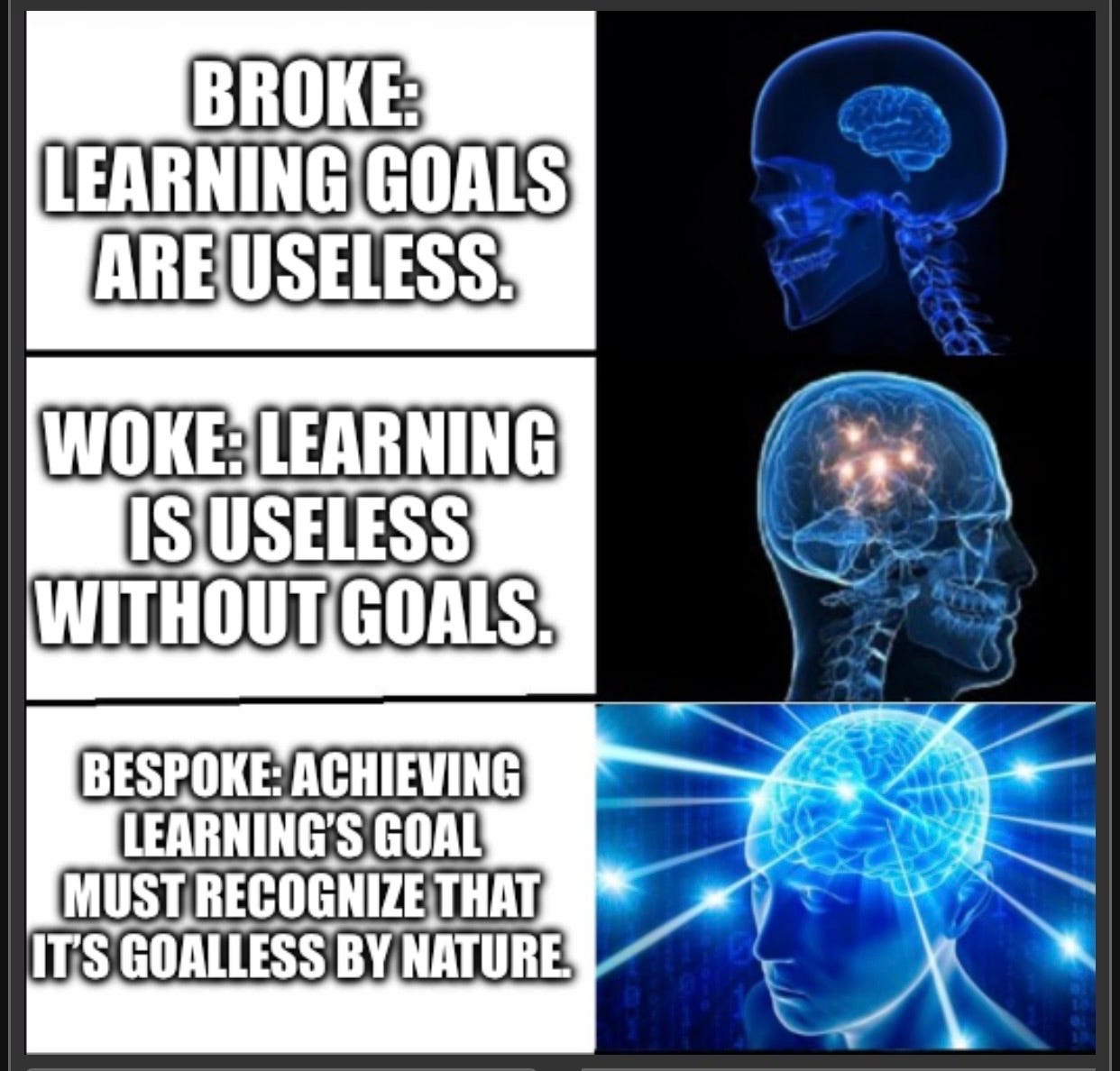
For those of you still with me, let me leave you with a provocative question rather than trying to “sum up” or “conclude” anything (can winding rants have conclusions?)
It seems plausible to me that ChatGPT is a better, more Socratic personalized tutor than most professors if your aim is to acquire, reorganize, present, or otherwise “transmit” knowledge of the sort academic disciplines prize above all else. Suppose, with me for one moment, that that’s right. Suppose the brick-and-mortar university still has something to offer, and suppose that that’s right value depends essentially on the community it houses or constitutes. What would effective (transformative) learning look like in such a place? In other words: What aspect of “teaching” can’t be automated, and is it plausibly the role of universities to offer such instruction?
This is a key issue I see many miss; often who are intelligent in and of themselves, but fail to realize.
One of my favorite quotes, “the great aim of education is not learning, but action,” nods to this.